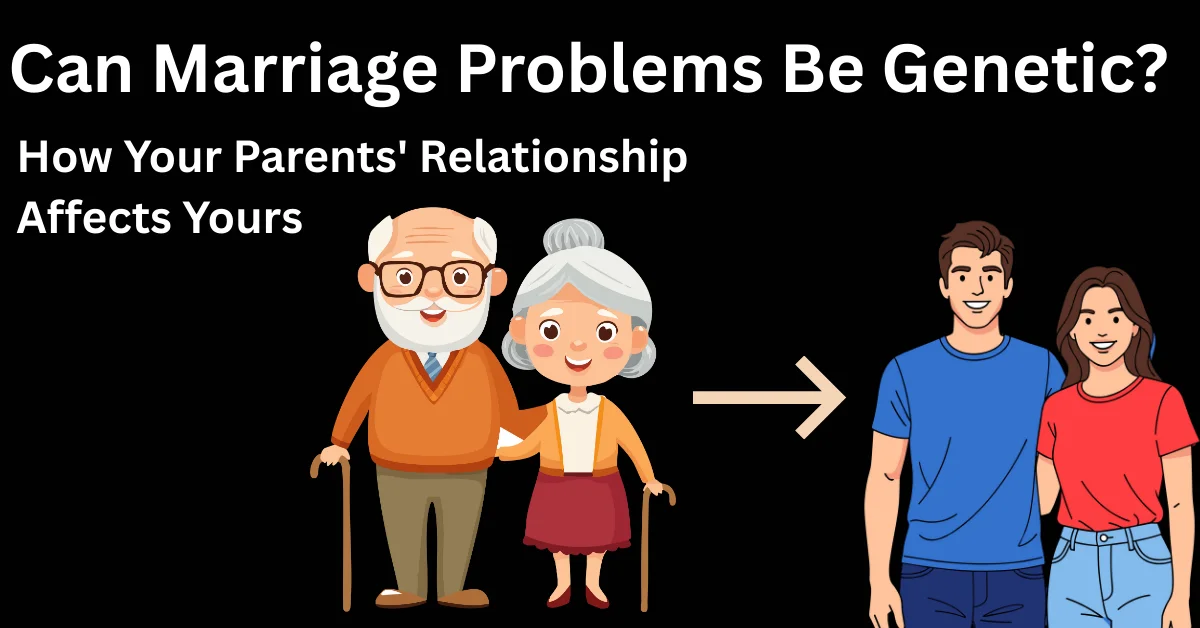
Sometimes, many people wonder if their parent’s marriage plays a part in their relationship with their partners. If your parents had a troubled marriage, does that mean you will also repeat the same emotional patterns and is it somehow written into your DNA?
Table of Contents
ToggleThe right answer is: No, you can’t carry marriage problems like your genes you get from your parents. But the right answer is a little more complicated than that.
You don’t carry your parent’s marital problems genetically, but you do carry your parent’s emotional patterns, beliefs and coping mechanisms which play a major role in your relationships.
It is important to understand this difference and break that cycle. In this article, we will unpack this question step by step.
Are relationship problems actually genetic?
There is no single “ divorce gene” or “unhappy marriage gene.” The biological factors don’t play any role in your marriage issues but your emotions do.
However, some studies show that there are some genetic personality traits that come from your parents. These include:
- Emotional sensitivity
- Impulsivity
- Anxiety or mood regulation
- Temperament
These little quirks can influence how someone handles stress, conflict or emotional closeness. For example, if anxiety runs in your family, you may be more prone to overthinking or fearing abandonment in relationships. But this doesn’t mean conflict is inevitable, it simply means awareness and emotional skills matter more.
While genetics may play a part in your behaviour, it’s the environment and experience that directs your decisions and reactions.
What You Really Inherit: Relationship Blueprints

Most of what people think of as “genetic” marital problems actually come from learned behaviour.
We watch our parent’s behaviour as we grow up and unintentionally pick their emotional patterns and behaviours, like:
- How they express love
- Handling of disagreements
- Apologising or refusing to
- Dealing with anger or silence
- Showing of respect or disrespect
These things embed in our minds subconsciously and frame how love and relationship looks like. If your parents communicated calmly and showed affection to each other, these skills will come naturally to you. But if their relationship was tense, distant, those patterns may feel “normal” to you, even if you don’t like them.
How Your Parents’ Relationships Affect Yours
Let’s look at the ways how the parental relationships show up in marriages or partnerships:
1. Conflict Resolution Styles
Now, think about how issues in marriage were resolved in your home. There are many people who repeat the same style their parents used to follow without even realising it. If you grew up in a home where disagreements used to explode, you might become defensive quickly. If conflict was avoided, you may struggle to speak up when something hurts. These aren’t character flaws, they’re learned survival strategies.
2. Attachment Styles
Many psychologists often talk about the attachment styles, which develop in childhood based on how safe and supported we felt emotionally. Your parents’
relationship play a big role here. Sometimes a parents’ unstable marriage with problems can lead to insecurity in your relationships, while a stable one often creates emotional confidence. But attachment styles can be changed with awareness, and therapy.
3. Beliefs About Marriage
When you are raised by unhappy parents, their actions make you believe that long-term relationships are disappointing. Therefore, it can influence your behaviour in your relationship, how much effort you put in and how you react to marital problems. The representation of your parents’ marriage affects your beliefs about marriage.
4. Emotional Regulation
Children often learn things by watching adults, even how to handle emotions. If your parents reacted calmly under stress then it makes your chances of handling conflict better and if they used to handle emotions differently then you learn that too. Marriage problems can bring stress and disagreement but how you manage those moments often traces back to what you saw growing up.
Does your parents’ divorce affect your love life?
As per statistics, people who have witnessed their parents’ divorce are more likely to experience marriage issues themselves but this is not destiny.
The increased risk usually comes from:
- Unresolved emotional trauma
- Poor conflict handling
- Fear of commitment or abandonment
- Lack of healthy relationship examples
While, many children who come from broken marriages with issues become more careful about their relationships. Some communicate better, value emotional safety more and work harder to avoid repeating the past. It’s your awareness that matters and not your background.
How You Can Build a Different Relationship

You are not your parents’ relationship.
The first step you can take is recognising the patterns and making a step towards changing them. When you reflect on your childhood and consciously choose different behaviours often leads to healthier relationships. It also helps you to find solutions for your marriage problems.
Here are some ways to break the cycle and change old patterns:
1. Make a list of things you saw as a child
You need to recognize everything that you saw as a child in order to understand your patterns in marital problems. Ask yourself, what did I learn about how love and conflict was handled. And the most important question you need to ask is what do you want to do differently in your relationships. When you start acknowledging these things you can start changing the patterns. Understanding and recognising marriage problems is the key to your solution.
2. Try to recognise your triggers
What is it that makes you react with strong emotions, and why do you feel this way? Questions like this would be able to recognise your triggers and help you find solutions to your marriage problems. Sometimes your childhood leaves a mark on you which comes out in adulthood in unexplained ways. Your fear of being ignored may come from the emotional neglect or overreacting to criticism comes from constant childhood blame. When you recognise this, you can respond rather than react.
3. Try to learn new communication skills
Skills like healthy communication, emotional regulation and boundary-setting can help in building healthy relationships. There are many things that you can learn like how to communicate better without arguing and how to listen to your partner without getting defensive. There are many relationship books, workshops and counseling sessions for marriage problems that can help you acquire these skills.
4. Choose your partner consciously
Many people unknowingly choose partners who feel familiar rather than healthy.
If chaos, emotional distance, or inconsistency feels like “chemistry,” it’s worth pausing and asking why. Familiarity doesn’t always mean safety.
5. Don’t Be Afraid of Support
Couples counseling for marriage problems isn’t a sign of failure. For many, it’s preventative care—like going to the gym for emotional health.
Individual therapy can also help untangle childhood patterns that show up in marriage.
So, Can Marriage Problems Be Genetic?
Not in the way most people fear. You may inherit certain emotional tendencies, but you inherit far more through observation and experience than through DNA. And unlike genes, learned patterns can be changed.
Your parents’ relationship may influence your starting point but it does not decide your ending.
With awareness, effort, and the willingness to learn healthier ways of relating, you can build a marriage that looks very different from the one you grew up watching.
And sometimes, creating a better relationship isn’t about blaming the past, it’s about understanding it well enough to move forward differently.

FAQs
1. Are marriage problems passed down through genes?
Marriage problems themselves are not genetic. There is no specific gene that causes relationship failure, constant conflict, or divorce. However, certain emotional traits such as anxiety, emotional sensitivity, or difficulty managing stress can run in families. These traits may influence how someone reacts in a relationship, but they do not determine the outcome of a marriage.
2. How does my parents’ relationship affect my marriage?
Your parents’ relationship often becomes your first example of what love and marriage look like. You may subconsciously learn how to express emotions, handle disagreements, or show affection by watching them. Even if you consciously disagree with their behaviour, those early experiences can still influence how you respond to situations in your own relationship.
3. If my parents had an unhappy marriage, does that mean mine will be too?
No. An unhappy marriage in your family does not mean you are destined for the same outcome. Many people who grow up in difficult households become more aware of what they don’t want and work actively to build healthier relationships. Awareness, communication skills, and emotional maturity matter far more than family history.
4. What are “learned relationship patterns”?
Learned relationship patterns are habits and beliefs about relationships that develop during childhood. These include how you deal with conflict, whether you avoid difficult conversations, how you express anger or affection, and how safe you feel being emotionally open. These patterns are learned from observing parents or caregivers over time.
5. Can these relationship patterns be changed?
Yes, learned patterns can be changed with effort and awareness. Self-reflection, honest conversations, therapy, and learning healthy communication skills can help you respond differently than you did in the past. Over time, these changes can lead to more stable, fulfilling, and emotionally secure relationships.
 The Holding Hands